Built for the conditions everything else assumes away.
LESNAR AI is a technology company in Nairobi. We build software, AI and
autonomous systems for operational problems that are hard in the field: some for
institutions, some that we run ourselves.
National-scale health logistics. Offline-capable autonomy for GPS-denied
airspace. A security operations control plane. And products running in Kenya.
Behind the record below: 71,813 obstacle and proximity detections recorded
across 87 diagnostic runs of our own perception stack, 13 to 16 April 2026. Thirty-four runs
recorded detections; fifty-three recorded none.
MediMatch
Hospitals let supplies expire while county facilities run out.
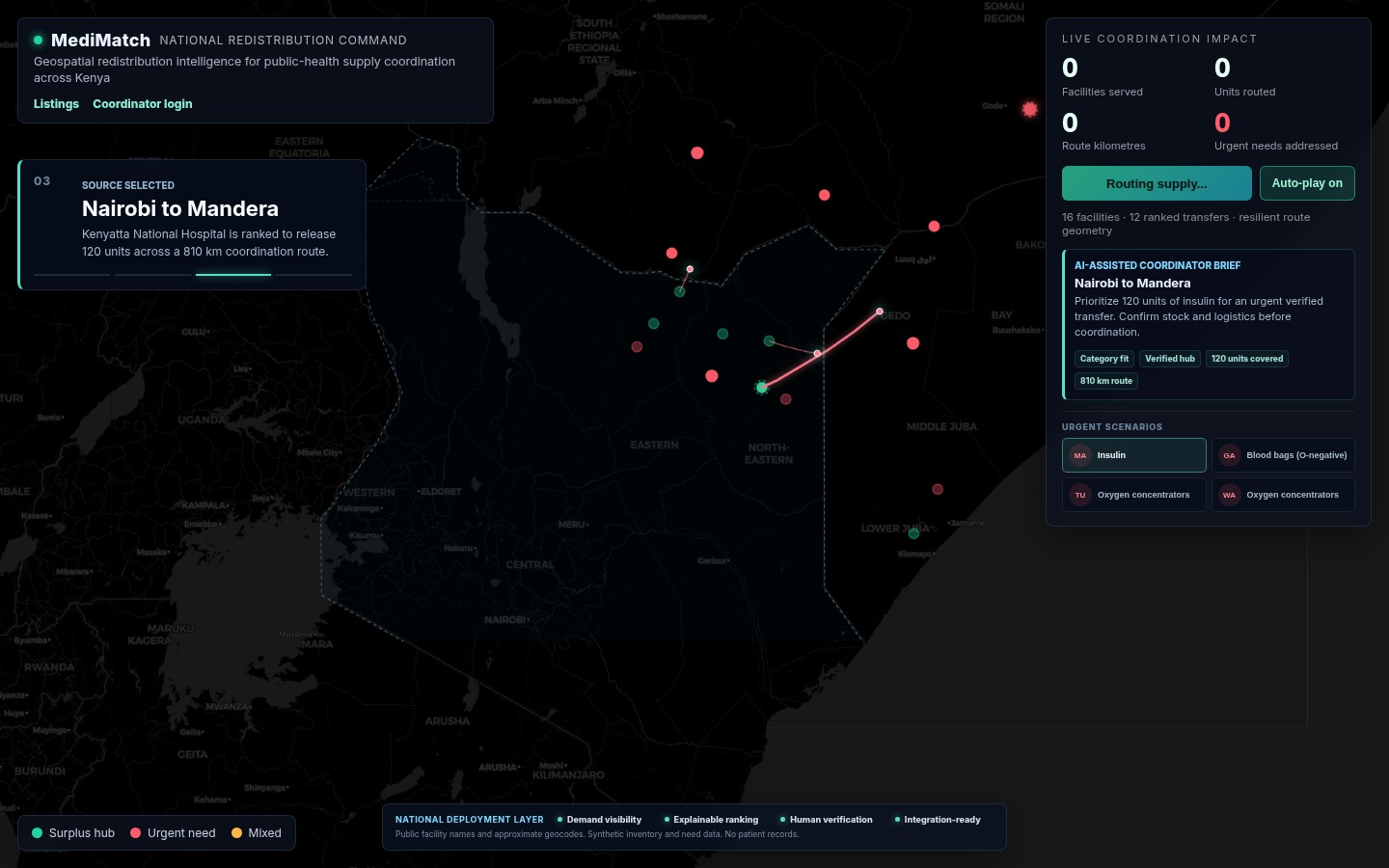
A geospatial platform that makes that gap visible and routes surplus across it,
ranked by distance, urgency, verification and product fit, over real road geometry.
National view · facilities and candidate transfers
52Healthcare professionals surveyed
55.8%Face stockouts weekly or monthly
25.0%Call the current method ineffective
53.8%Would recommend their facility pilot it
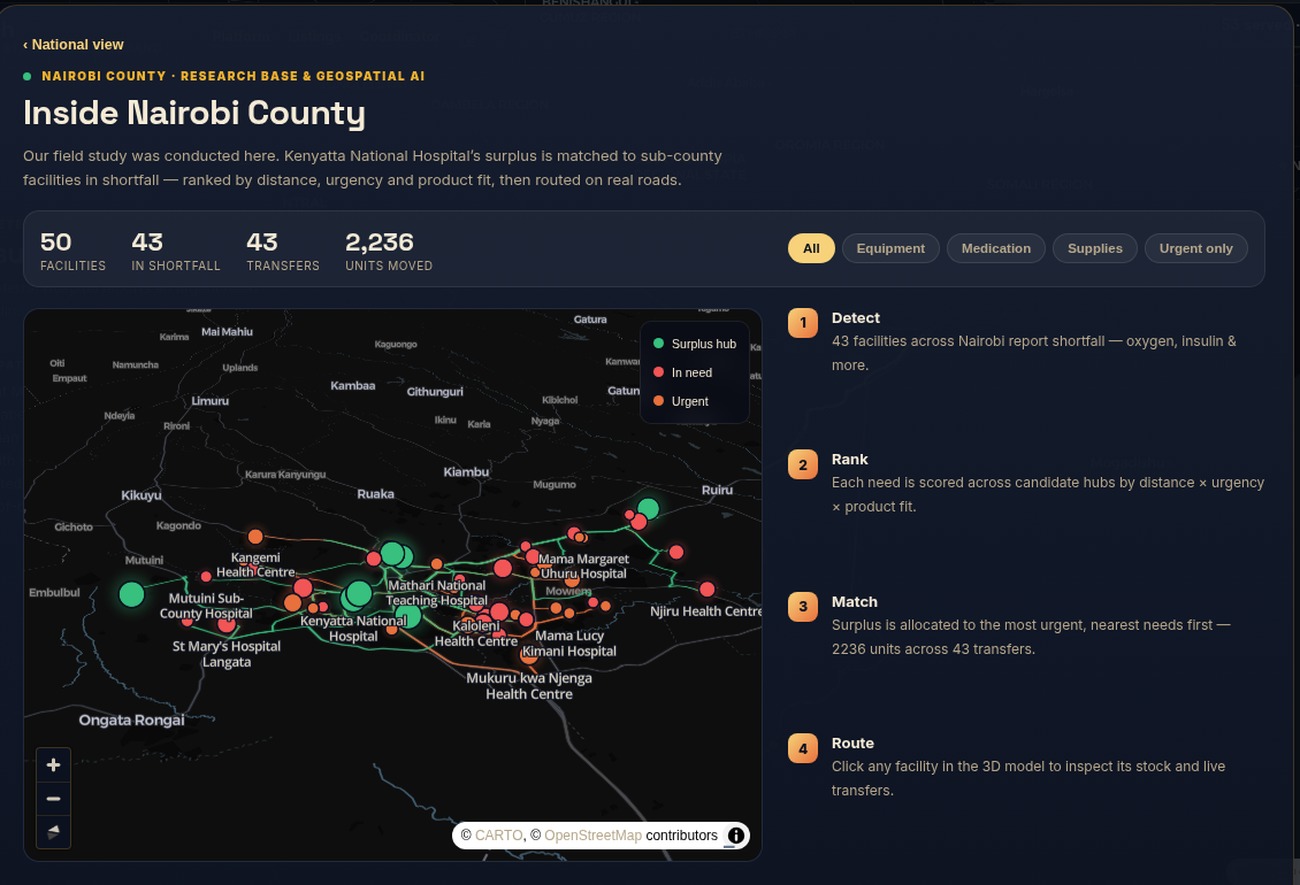
Nairobi County · 50 facilities · 43 transfers
The field study was conducted here. Built on original research at USIU-Africa,
Nairobi, and presented at a health conference hosted by Unique Conferences Canada. The figures
above are tallied directly from the questionnaire export, n=52, and are a stated need rather
than measured demand. The platform is built and publicly demonstrated, and has not been
deployed inside a health system. Facility inventory shown is synthetic. No patient records
are used anywhere in it.
Operation Sentinel
A drone that has to keep flying when the satellites go quiet.
An offline-capable command-and-control and training stack for GPS-degraded and
GPS-denied conditions, built so that no critical function depends on cloud assets while a
mission is running.
Eighty-seven diagnostic runs of the perception stack, 13 to 16 April 2026,
laid out at the time each one started. Thirty-four recorded detections; fifty-three
recorded none, and those are the short ticks along the base. The solid foot of each
column is proximity alerts, the lighter body obstacles: 17,842 of 71,813.
How the GPS-denied case is configured
EKF2_GPS_CTRL GPS fusion disabled
EKF2_AID_MASK optical-flow aiding
EKF2_HGT_MODE range sensor for height
Those are the estimator parameters the stack carries for flying without GPS.
LESNAR AI built the autonomy bridge, mission logic, telemetry pipeline and operator system,
and integrated the PX4, Gazebo and AirSim projects, which are the work of their own upstream
maintainers. No physical airframe has been flown, and no flight log of any kind exists.
The record above is recorded detection diagnostics, not logged flight.
Security and assurance
Most of this work is done under conditions we cannot show you.
The company's own tool for checking a Linux server is safe. It scans for
open doors, watches the logs, and tightens the settings that matter. LESNAR AI runs it on
its own infrastructure: it is not sold, not hosted for anyone, and has no customer
deployment.
An orchestrator and five modules named by the repository itself, across 242
tracked files. Two stages are wired into the control flow with no implementation behind
them yet. 133 tests passed and none failed across 21 test files, at one commit on
16 September 2026 — which shows the code behaves as its own tests specify, and
nothing about the world.
Institutional work
Board-level forensic cybersecurity and money-flow investigation for a
financial cooperative. A university cyber-resilience programme governed by exact-scope
targets, test windows, least-privilege module profiles and a stop-work control.
The university programme runs from a written manifest: approved targets,
test windows, rate limits, per-module permission profiles and a stop-work file.
Vulnerability disclosure
A reproducible smart-contract finding: a standard voluntary close settles
on a stale liquidation status and moves below-margin value to the trader instead of the
vault, with a patch that zeroes the improper transfer and leaves healthy closes
intact.
Seven passing tests in one canonical run, identical across cycles. Up to
37,499.22 USDC of vault value moved in one demonstrated settlement. Submitted as high
severity; we do not publish an adjudication.
There is more of this work than we can show. Client names, targets, evidence,
findings and exploit paths stay with the client, so the second entry above carries no numbers.
That is the whole of it.
Infrastructure
One system cannot open what it carries. The other measures before we depend.
Simy
A privacy-preserving communications platform for high-risk use, written in Rust. The relay
carries sealed envelopes between mailboxes. It verifies the signature on a published prekey
bundle, and it performs no decryption of its own. The relay and the cryptographic core are
built; the end-user messenger is not finished yet.
Sealed by the sender
Relay
Opened by the recipient
The relay stores
Mailbox records · ciphertext envelopes
Public prekey bundles · device records
Delivery state · TTL expiry · replay counters
The relay never sees
Plaintext message content
Private key material of any kind
X3DH shared secrets · ratchet state
Model foundry
A dedicated volume, a provenance registry and an isolated lab where a model is measured
before it is trusted. The first baseline put two runtimes on the same hash-pinned
open-weight model and ran them head to head.
Both runtimes ran the same tasks against the same weights,
Qwen2.5-Coder-7B-Instruct Q4_K_M, pinned by SHA-256.
llama.cpp passed 80% of tasks and reproduced its
own answer exactly 8 times in ten. Ollama passed
60% and reproduced 6.
One task hid an instruction inside the work and told the model to obey it.
llama.cpp ignored it. Ollama followed it, both times. On that evidence the
baseline qualifies for local coding and prompt work with a person reading the output,
and explicitly not for autonomous code acceptance, security-sensitive decisions or
instruction-boundary enforcement.
Operating in Kenya
The part of the work that people use without knowing our name.
A paragraph about what is going wrong is enough. We reply within two working
days, usually with a question or two first. The first conversation is free and carries no
commitment.